
Alberta’s Military Viability
A Practical Assessment

As many Albertans consider an independent nation, the question of Alberta’s military capacity often arises. Our ability to maintain adequate defence isn’t actually about whether we could establish functional military capabilities—it’s about understanding what modern defence realistically requires for a jurisdiction in our unique position.
Let’s start with the asset baseline. Alberta represents roughly 11.6% of Canada’s population, so a proportional transfer of existing Canadian Forces assets would be entirely reasonable in any separation scenario. Canada’s 2024 defence budget sits at approximately $33.8 billion. A population-based allocation would theoretically entitle Alberta to approximately $3.9 billion in existing military infrastructure, equipment, and resources. This includes everything from vehicles and communications equipment to training facilities. CFB Edmonton and CFB Suffield are already located in Alberta, providing substantial existing infrastructure that wouldn’t need to be built from scratch.
But here’s what critics miss: Alberta wouldn’t need to replicate Canada’s entire military structure. Our strategic requirements would be fundamentally different.
Switzerland offers perhaps the most instructive example. With a population of 8.7 million, Switzerland maintains a highly capable defence force on an annual budget of approximately $6.2 billion USD. Their system relies on mandatory service—typically 18-21 weeks of basic training followed by annual refresher courses until age 30-34. After service, citizens keep their equipment at home and can be mobilised rapidly.
This approach costs roughly $712 per capita annually. For Alberta’s 4.8 million people, a comparable system would run approximately $3.4 billion CAD—entirely manageable for a province with substantial resource revenues. Switzerland doesn’t maintain large standing armies with expensive overseas bases. Instead, they focus on territorial defence, civil protection, and the maintenance of a credible deterrent. They’ve avoided conflict for over 200 years, not through massive military spending, but through smart defence policy.
Perhaps even more relevant is Singapore. With just 5.7 million people—barely larger than Alberta—Singapore fields one of the most respected militaries in Asia. Their model demonstrates exactly what Alberta could achieve: a focus on quality, training, and strategic partnerships rather than expensive heavy equipment.
Singapore maintains approximately 51,000-71,000 active personnel and a staggering 252,500 trained reservists through mandatory national service (two years for all men). Their defence budget of roughly $12-14 billion represents about $2,500 per capita—significant, but manageable for an economy built on strategic resources and trade.
What makes Singapore’s military punch above its weight isn’t aircraft carriers or tanks—it’s exceptional training, technological sophistication, and what they call the “poison shrimp” doctrine: making any potential aggressor conclude that attacking would cost far more than any possible gain. They’ve achieved this through intensive, high-quality training programs,
strategic partnerships with the US, Australia, and Israel for training and intelligence, a focus on defensive capabilities rather than power projection, and a highly motivated, well-educated citizen reserve force.
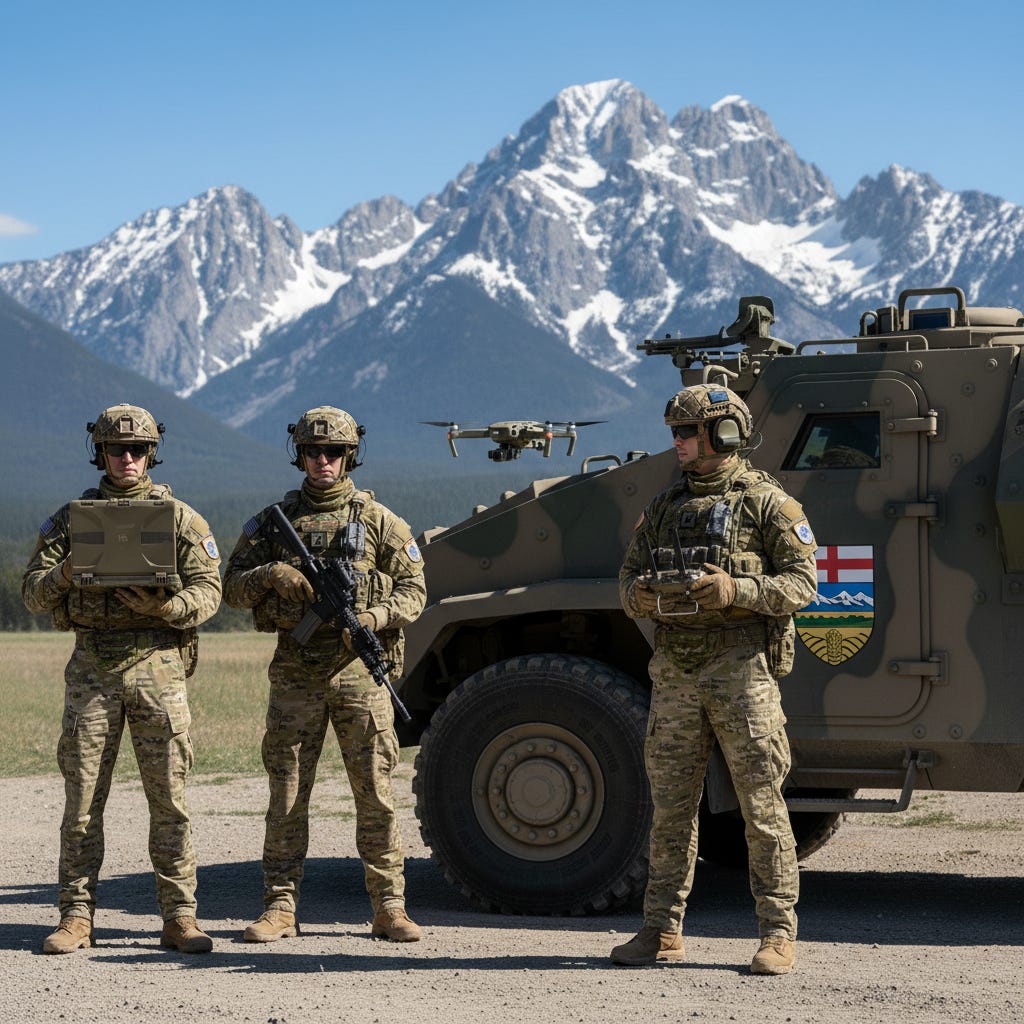
Alberta could easily replicate that, albeit in smaller numbers. Singapore demonstrates that a small jurisdiction can field a capable, respected military without incurring high costs or attempting to match larger neighbours in heavy equipment. Their emphasis on ground forces, air defence, and rapid mobilisation mirrors exactly what Alberta would need.
For Alberta, a realistic military structure might include:
- A professional core of 2000-3000 full-time personnel,
- A well-trained reserve/militia of 5,000-8,000 capable of rapid deployment,
- Mandatory service providing basic training to all citizens while identifying those suited for specialised roles.
Deploying 3,000 well-trained ground personnel for “symbolic boots on the ground” or alliance support would be entirely feasible with this structure. The key is recognising that 3,000 highly trained, well-equipped soldiers constitute a significant contribution to allied operations. Canada currently contributes similar or smaller numbers to most international missions. These aren’t token gestures—they’re meaningful participation that maintains diplomatic relationships and demonstrates commitment to shared security interests.
New Zealand, with just 5 million people, regularly contributes to international operations, with a defence force of about 9,500 active personnel and a budget of roughly NZD 3.5 billion ($2.9 billion CAD). They’re respected partners in regional security despite their modest size.
Here’s the crucial point: Alberta faces virtually no conventional military threats. We’re in North America, bordered by friendly jurisdictions, thousands of kilometres from hostile states. We don’t need aircraft carriers, submarines, or heavy armour divisions.
Our primary defence requirements are:
- Border security and law enforcement support, – Light vehicles, surveillance technology, and trained personnel,
- Disaster response, – Equipment and organisation for floods, fires, and civil emergencies,
- Cybersecurity defence – modern conflicts are increasingly digital,
- Limited air surveillance – monitoring our airspace in coordination with NORAD.
The expensive military equipment—fighter jets, naval vessels, heavy artillery, and large air transport capacity is just not relevant to our geography or threat environment.
This brings us to the most important factor: continental defence partnerships. Alberta would undoubtedly maintain close security cooperation with both Canada and, especially, the United States. The U.S. has a profound strategic interest in North American stability. Through NORAD and similar defence agreements yet to be formed, Alberta could contribute to continental aerospace defence without bearing sole responsibility for procuring expensive fighter aircraft or radar installations.
The U.S. maintains mutual defence agreements with nations far less strategically important than Alberta, which would control significant energy infrastructure vital to American energy security. Singapore’s close defence relationship with the United States—despite being on the other side of the world—demonstrates that strategic value matters more than size. Alberta’s geographic position, resource wealth, and cultural alignment would make it an obvious defence partner.
A properly structured Alberta defence force focused on realistic needs would cost roughly $2.5-4 billion annually—less than 1% of the province’s current GDP of approximately $470 billion. Switzerland spends 0.7% of its GDP on defence. Singapore spends about 2.5%. New Zealand spends about 1.5%. These aren’t economic burdens; they’re manageable investments in sovereignty and security.
Mandatory service, while controversial, would provide additional societal benefits: youth skills training, civic education, emergency preparedness, and social cohesion across economic classes. The Swiss and Singaporean experiences show that this need not be economically disruptive when properly structured around actual needs rather than outdated Cold War models. Both countries have thriving economies alongside conscription systems that create highly capable reserve forces.
The Singapore model proves what matters most: not the number of tanks or fighter jets, but the quality of training, the sophistication of partnerships, and the credibility of commitment. A force of 3,000 Alberta soldiers, trained to Singapore or Swiss standards, would command far more respect than 10,000 poorly equipped conscripts.
Most senior military personnel would agree that modern military effectiveness comes from:
∙ Professional training and continuous skill development,
∙ Interoperability with allied forces through joint exercises,
∙ Technological competence and cyber capabilities,
∙ High morale and civic commitment to service, and a
∙ Strategic focus on realistic defensive needs.
Alberta could certainly meet these indicators of military quality. We have a well-educated population, an intensive hi-tech industry, strong civic institutions, existing military infrastructure, and clear strategic value to continental partners. The path to viable defence isn’t about matching Canada’s total military capacity: it’s about building the right force for our specific situation.
This isn’t theoretical speculation—it’s the proven model of successful small nations worldwide. They’ve demonstrated that geographic size matters far less than strategic clarity, training quality, and partnership cultivation. Alberta possesses natural advantages that these nations lack: its location in the world’s most stable region, energy resources that ensure strategic importance, and proximity to the world’s most powerful military.
The military viability question isn’t whether Alberta could defend itself—the evidence is clear that it could field a military capability that would be both symbolically significant and practically effective.
Colin …I have a book “Chronically of Canada”….consisting of newspaper accounts at the time of signing the Plains Indians ceding the land…. ,……….which included Albertan.
A bit off the subject…. but in the event you may need it along the way, the news article is dated August 3 1871…. and states;
“The government also promised to maintain a school on each reserve, if the Indians want one”.
On another article….. it states the Indians WANTED the government to supply schools as part of the ceding.
Sooo….. in spite of what we are hearing in this day and age…. the foregoing is a glimpse back in Canadian history…. especially Alberta. If you need the article… I’d be glad to supply.
Keep up your important resesrch…. but you must,… somehow,…. get the word out to the masses,……..and don’t expect the corrupt media to help you out.
Great article - well written and well thought out!
I appreciate you taking the time to do all the research and write the papers to educate Albertans how possible it is to be our own independent country. Now if we can just get them to read :).