
The Morning After:
Alberta's Post Referendum 365 Day Playbook.

A clear “yes” vote for Alberta independence would rattle the political establishment, but not for the reasons its critics claim. Earthquakes matter less for the shock they create than for what they expose. A yes vote would not be a reckless leap off a cliff. It would be Alberta choosing, calmly and deliberately, to walk through a door it has been constructing for generations.
The morning after the vote would NOT be defined by disruption, panic, or improvisation. It would be defined by intent, sequencing, and negotiating discipline. The real story begins after the celebrations fade, in the first 365 days, when Alberta moves from mandate to mechanics.
Let’s assume the provincial government has sufficient wisdom to set a firm, self-imposed one-year timeline to conclude negotiations in good faith, consistent with the Clarity Act framework.
That decision alone would send a powerful signal; Alberta is not seeking confrontation or delay. It is seeking resolution. A clock focuses minds — in Edmonton and Ottawa alike.
Day 1 to Day 30: Control the Narrative, Lock Down Stability
The immediate post-vote period is about narrative dominance. The most dangerous phase of any separation process is not legal or financial; it is psychological. We have already seen the fear-mongering that Canada’s legacy media can produce. Initially, markets, institutions, and individuals respond less to facts than to uncertainty and propaganda.
The Alberta government’s first responsibility would be to remove uncertainty wherever possible. Pass the “Continuity of Laws” Act on day one. Alberta would not wake up to institutional collapse, legal confusion, or administrative paralysis. It would wake up governed, regulated, policed, adjudicated, taxed, and serviced exactly as it was the day before — by design.
The message would be simple and relentlessly repeated: government functions continue, services continue, obligations continue, pay cheques continue. This is not idealism; it is risk management.
Simultaneously, Alberta would formally notify Ottawa of the referendum result and its intention to enter structured negotiations. Expect Ottawa to acknowledge reluctantly and conditionally, if at all. That is politics. What matters is that a process is initiated, not that it is warmly embraced.
Internally, the province would rapidly build a dedicated negotiating authority, with specific teams for each area. It would be insulated from day-to-day politics, staffed by Alberta’s best: constitutional lawyers, fiscal experts, Indigenous relations specialists, and trade negotiators.
Day 30 to Day 90: Define the Battlefield
The next phase is about defining what is being negotiated and how. Alberta’s objective would be to avoid one sprawling, ideological negotiation and instead force Ottawa into parallel, technical stovepipes.
This compartmentalisation matters. It prevents any single issue — pensions, for example — from being held hostage to extract concessions elsewhere. Ottawa will try. Alberta’s leverage lies partly in refusing to play that game.
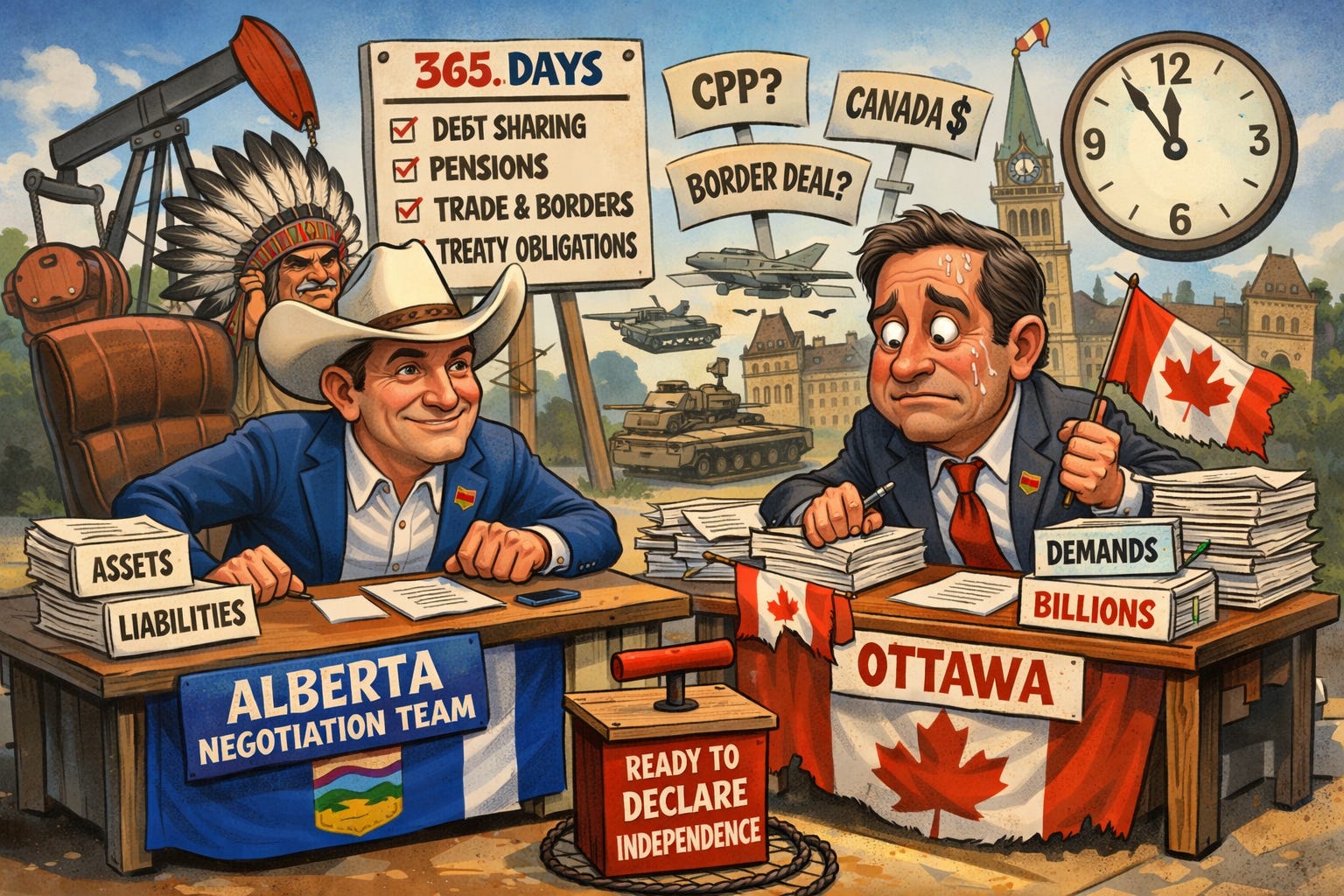
The major files will be inherently adversarial but could be clearly delineated:
Fiscal Settlement
Alberta’s objective would be a fair and defensible division of assets and liabilities. This means resisting a crude population-only debt allocation in favour of an accounting that reflects Alberta’s historic net contributions, federal assets located within the province, and prior infrastructure investments. Alberta’s goal would be in avoiding any disruption to credit markets or public finances.
Debt and Assets will be the most politically charged. Ottawa will default to population share arithmetic. Alberta will counter with contribution-based logic and asset offsetting. This will not be resolved quickly, and that is acceptable.
Pensions and Social Programs
Alberta would aim to preserve continuity for contributors and beneficiaries while securing maximum long-term flexibility. The immediate goal would be uninterrupted participation during negotiations, paired with the legal and administrative right to withdraw or redesign programs, particularly pensions, once a sovereign framework is established. Stability first.
The CPP will generate maximum public anxiety and maximum misinformation. Alberta’s priority would be reassurance. The rational approach is continuity first, optionality later. Alberta must accentuate the benefits of it’s own pension plan while simultaneously reassuring current CPP recipients. Expect many public theatrics but private pragmatism.
Indigenous Treaties and Obligations
Alberta’s position would be explicit: treaties remain binding and Crown obligations carry forward. Alberta would seek to affirm these commitments early, while creating space for future bilateral or trilateral agreements where Indigenous governments wish to renegotiate fiscal, jurisdictional, or governance arrangements. Each Indigenous government will have a choice. No unilateral changes; no legal shortcuts. This affirmation will quickly mitigate the misinformation on this subject.
Indigenous Relations will be closely watched domestically and internationally. Alberta’s posture would need to be explicit: treaties remain binding; consultation is mandatory; Indigenous governments are partners going forward, not afterthoughts.
Any changes to governance or fiscal arrangements would occur only through consent-based negotiations with Indigenous governments themselves. First Nations can decide for themselves whether they want Canada to continue administering treaties, reserves, and the Indian Act, or whether they wish to consent to Alberta assuming the Crown’s role. Any hint otherwise would be reputational self-harm.
Passports, Trade and Mobility
The objective here would be, again, continuity and predictability. Alberta would push for agreements guaranteeing the free movement of goods, services, capital, and labor during the transition period. This file would be treated as non-ideological and time-sensitive, insulating businesses and workers from political uncertainty.
Defense, Borders, and International Representation
Alberta would seek transitional cooperation rather than immediate separation. This includes continued collaboration on border management, airspace, and defense under interim arrangements while longer-term frameworks are negotiated. There would be no rush to reinvent systems that are working.
During this period, Alberta would also actively negotiate Defense pacts with other Western democracies. The goal is security and credibility, not symbolic posturing.
Constitutional Matters
Alberta would aim to minimise constitutional entanglement during the transition. Rather than reopening Canada’s Constitution, the province would seek targeted, bilateral agreements sufficient to enable separation while clarifying Alberta’s obligations during the interim period.
The objective is legal clarity without submitting to the 7/50 rule or admitting to the requirement for any Constitutional amendment that requires Alberta’s participation. That is the leverage offered by a successful referendum.
Day 90 to 365: Negotiating With Deadlines
As negotiations mature, the tone will harden. That is unavoidable. Ottawa will test resolve. Alberta will test boundaries. Media and online coverage will oscillate between extreme alarmism and triumphalism. None of this should dictate policy.
The strategic advantage Alberta holds is that it is not negotiating from a position of operational weakness. It already administers the bulk of public services that affect daily life. The large bulk of the necessary institutions are already in place. The successful referendum has given Alberta the moral strength and conviction required. That reality quietly shifts leverage. Ottawa cannot credibly threaten Alberta without harming Canadians as well — politically and legally.
Expect incremental agreements. Memoranda of understanding. Transitional compacts. Sunset clauses. Shared administration where efficient. This is not indecision; it is how complex separations actually succeed.
Crucially, Alberta would not need to complete every aspect of independence within a single year. The obligation is to negotiate in good faith, not to immediately achieve instant, fully-formed sovereignty. The first year is about establishing irreversible momentum while preserving stability, with the clear understanding that Alberta retains the authority to declare independence at a time of its choosing if negotiations stall or cease to be conducted in good faith. The first year is about locking in irreversible momentum while preserving stability.
The post-referendum year would not be dramatic in the way critics predict — nor static in the way supporters sometimes imply. It would be technical, disciplined, occasionally frustrating, and relentlessly procedural. That is a feature, not a flaw.
The real question is not whether the province can manage the first year. It clearly can. The question is whether Albertans are prepared for a process that rewards patience, competence, and realism over slogans, continued subordination and climate ideology.
Independence will not be won in a single vote. It will be earned in the months that follow, through steady governance, hard-negotiated agreements from a position of strength, and an insistence that political change does not require social or economic disruption.
This phase would not resolve every issue. It is not meant to. Its purpose would be to set the terms of engagement, reduce uncertainty, and move the conversation from misinformation and “what ifs” to a solid foundation for a new sovereign Alberta.
Independence will be built not in the celebratory heat of a referendum night, but in the steady, methodical work that must follow.
Great piece. However, I don't believe the 7/50 rule, or opening the Canadian constitution has any relevance in the negotiations and I believe Rise of Alberta posted a graphic just this week on this very issue. Am I wrong on this?
Great job. Please forward to Premier Smith! She should at least have a "shadow" minister of post-sovereignty vote action plans.